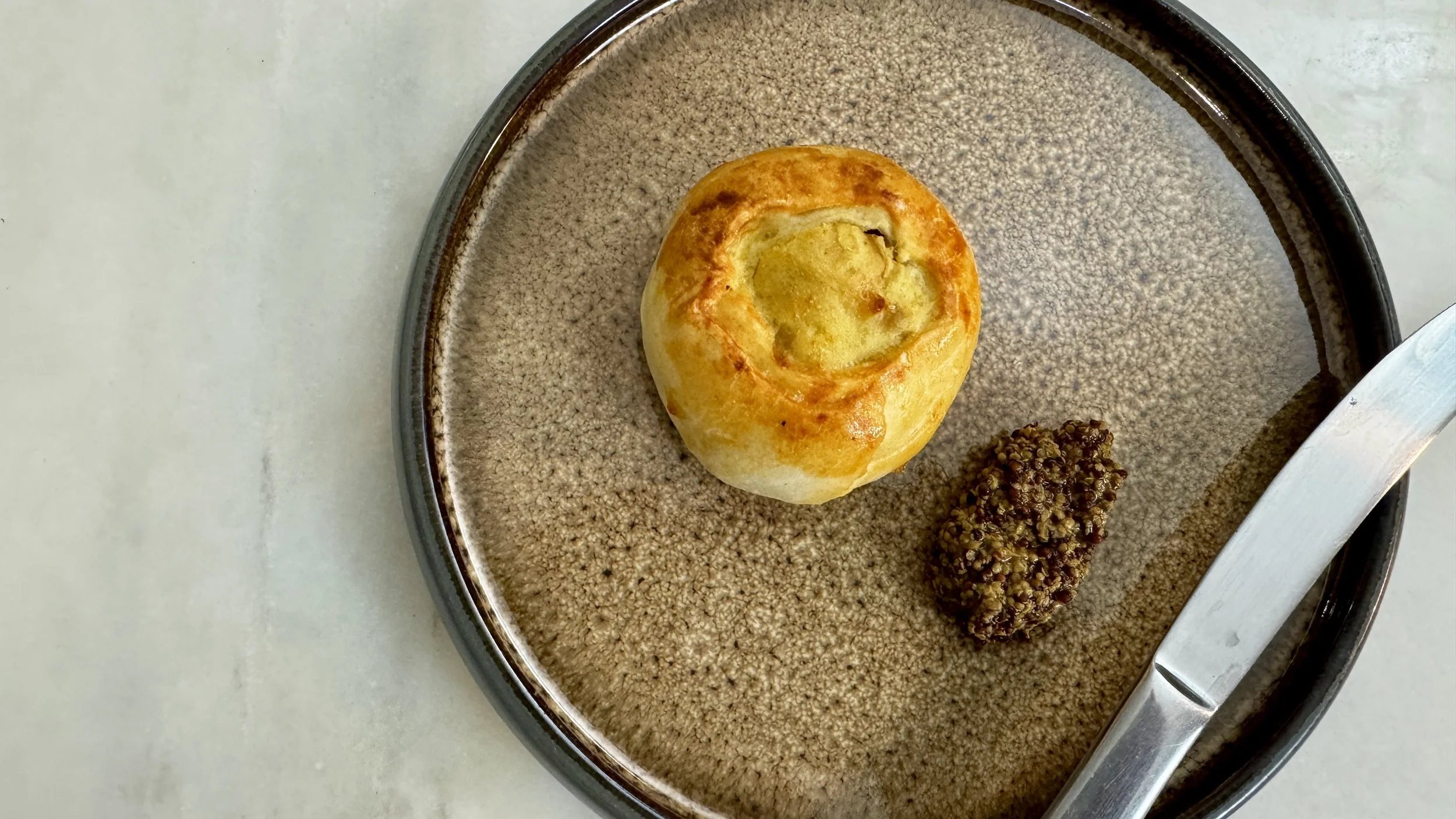
Potato Knish with Whole Grain Mustard
Potato knishes are working food: portable, filling, and built for long days. This baked version uses a simple dough rolled into a thin rectangle, filled, rolled into a log, then portioned and sealed—fast, tidy, and ideal for making a tray at a time.
Serve warm or at room temperature. Whole grain mustard is optional.
Watch my video to follow along step-by-step.
Oven-Roasted Tomato Soup
Yield: 10–12 knishes (medium)
Prep: 35 minutes Resting: 30 minutes (dough) + cooling time for filling Bake: 20–25 minutes Total: about 1 hour 45 minutes
Ingredients
Dough
3 cups (375 g) all-purpose flour
1 tsp (5 g) fine sea salt
1 tsp (4 g) baking powder (optional)
1 large egg
1/3 cup (80 ml) neutral oil or light olive oil
3/4 cup (180 ml) warm water, plus 1–2 tbsp (15–30 ml) as needed
Filling
2 1/2 lb (1.15 kg) potatoes, peeled and cut into chunks
2 large onions, finely chopped
3 tbsp (45 ml) neutral oil or olive oil
1 1/2 tsp (8 g) fine sea salt, plus to taste
1/2 tsp (1 g) black pepper, plus to taste
Egg wash
1 egg
1 tbsp (15 ml) water
Optional to serve: Choice of mustard
Method
1) Make the filling
Boil the potatoes in salted water until very tender, 15–20 minutes. Drain well.
While the potatoes cook, sauté the onions in oil over medium-low heat until deeply golden, 10–15 minutes.
Mash the potatoes while hot, then mix in the onions.
Season with salt and pepper. Set aside to cool to room temperature.
2) Make the dough
In a large bowl, whisk together the flour, salt, and baking powder (if using).
Add the egg, oil, and warm water. Mix until a shaggy dough forms.
Knead 3–5 minutes until smooth.
Cover and rest 30 minutes.
3) Roll, fill, and form the log
Heat oven to 400°F (205°C). Line a sheet pan with parchment and lightly oil it.
On a lightly floured surface, roll the dough into a thin rectangle (use your counter size; thinner is better than thick).
Place the filling in a continuous line along one long side, leaving a small margin for sealing.
Roll the dough up into a log around the filling.
Lightly wet the long seam with water and seal firmly.
4) Portion and seal
Using the side of your hand, mark the log into equal portions, then cut (10–12).
Pinch the ends of each piece closed.
Place on the oiled parchment-lined tray.
Flatten each knish slightly into a thick puck.
5) Egg wash and bake
Whisk egg and water. Brush the tops.
Bake 20–25 minutes, until glossy and deep golden.
Cool 10 minutes before serving.
Serving
Serve warm or at room temperature.
Grainy mustard is optional.
Storage and reheating
Refrigerate: up to 4 days.
Reheat (crisp): 350°F (175°C) for 10–12 minutes.
Freeze (baked): up to 2 months. Reheat from frozen at 350°F (175°C) for 18–22 minutes..
Larder Notes
Cool the filling: Warm filling will melt the dough and make sealing difficult.
Brown the onions well: This is where most of the flavor comes from.
Roll the dough thin: Thick dough makes heavy knishes.
Variations
Kasha knishes: Replace part of the potato with cooked buckwheat (kasha) and extra onion.
Cabbage-onion knishes: Swap potato for sautéed cabbage and onion (well cooked and well drained)
Peppery knishes: Add more black pepper for a sharper, deli-style bite..
© 2026 Gary R. Rice. All rights reserved.
This work, including all original recipes, text, images, and related media, is the intellectual property of Gary R. Rice. No part of this content may be reproduced, published, distributed, or adapted in any form without prior written consent from the author.
Personal, non-commercial use is permitted with clear attribution. Commercial use, including publication, broadcast, or syndication, is strictly prohibited without express permission.
All rights to this content are retained personally by Gary R. Rice, regardless of any business or channel name under which the material is published.