German Chocolate Cake
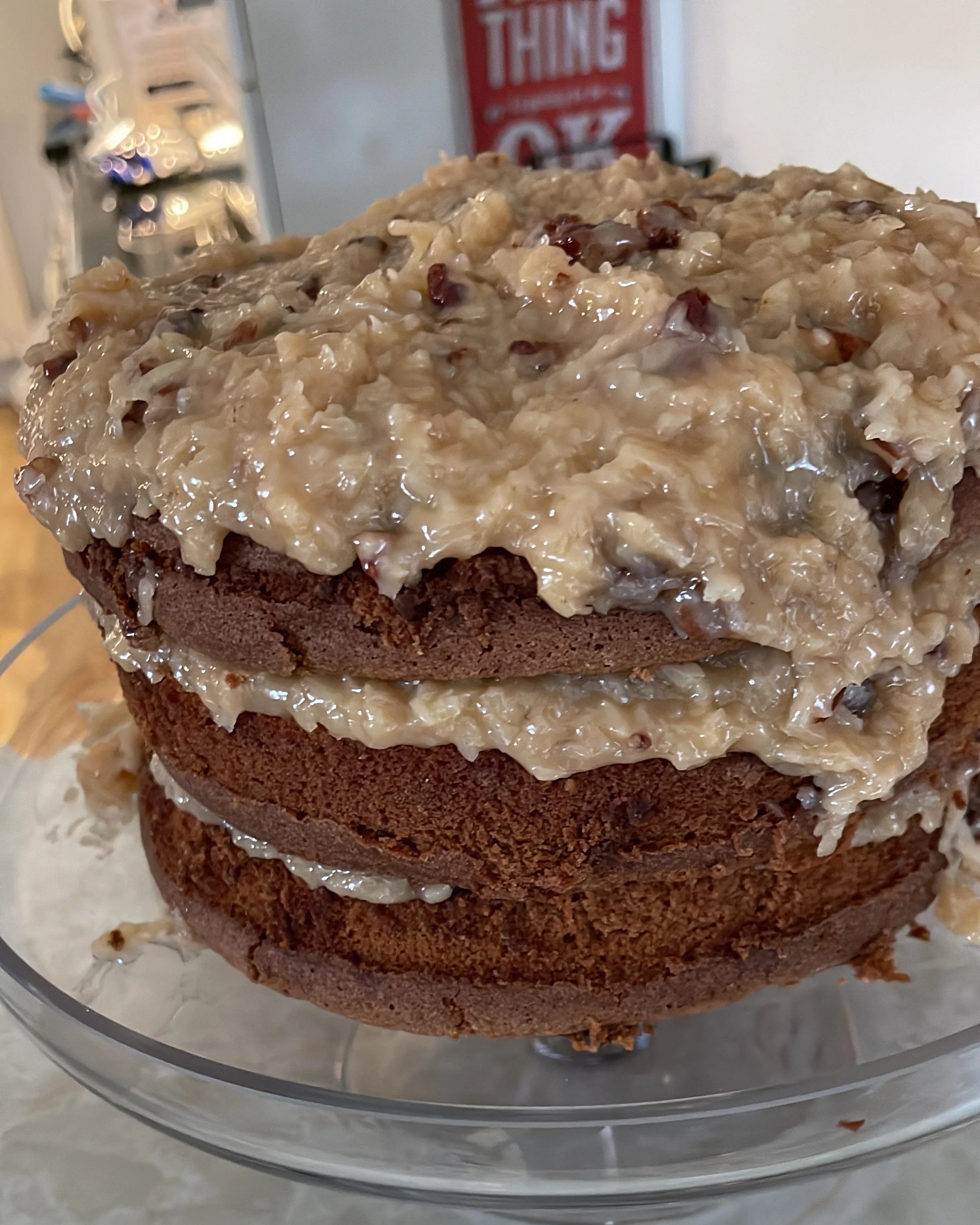
Three-layer German Chocolate Cake
The cake that became an American classic was propelled to national popularity after Mrs. George Clay’s recipe appeared in The Dallas Morning News in 1957
German Chocolate Cake is not German at all. Its name comes from German’s Sweet Chocolate, the baking chocolate developed by Samuel German for Baker’s in the nineteenth century.
This version retains the characteristic three light chocolate layers, beaten egg whites and coconut-pecan frosting, while making a few considered adjustments to the 1957 formula: unsalted butter replaces shortening, strong dark-roast coffee replaces the boiling water used to melt the chocolate, and a small amount of cinnamon may be added to reinforce the chocolate’s naturally warm spice notes.
Watch my video to follow along step-by-step.
Gary’s German Chocolate Cake
Makes: One 3-layer, 9-inch cake
Oven: 350°F (175°C)
Ingredients
For the Cake
4 oz (113 g) Baker’s German’s Sweet Chocolate
½ cup (120 ml) strong brewed dark-roast coffee, hot
1 cup (225 g) unsalted butter, softened
2 cups (400 g) granulated sugar
4 large eggs, separated
1 teaspoon vanilla extract
2½ cups (300 g) cake flour, sifted
1 teaspoon baking soda
½ teaspoon fine sea salt
¼ teaspoon ground cinnamon, optional
1 cup (240 ml) buttermilk
For the Coconut-Pecan Frosting
1 can (12 fl oz / 350 ml) evaporated milk
1½ cups (300 g) granulated sugar
4 large egg yolks
¾ cup (170 g) unsalted butter
1½ teaspoons vanilla extract
2⅔ cups sweetened shredded coconut
1½ cups chopped pecans, untoasted
Method
Make the Cake
Prepare the pans.
Heat the oven to 350°F (175°C). Grease three 9-inch round cake pans and line the bottoms with parchment paper.Melt the chocolate.
Break the German’s Sweet Chocolate into pieces and place in a bowl. Pour the hot coffee over the chocolate and stir until completely melted and smooth. Set aside to cool.Prepare the eggs and dry ingredients.
Separate the eggs, keeping the whites in a clean mixing bowl for beating later. Sift together the cake flour, baking soda, salt and cinnamon, if using.Cream the butter and sugar.
Beat the softened butter and sugar until light and fluffy.Add the yolks and chocolate.
Add the four egg yolks one at a time, beating well after each addition. Beat in the cooled chocolate-coffee mixture and vanilla until thoroughly combined.Add the flour and buttermilk.
Add the dry ingredients alternately with the buttermilk, beginning and ending with the dry ingredients. Mix after each addition just until incorporated.Beat and fold in the egg whites.
Beat the egg whites until stiff peaks form. Gently fold the freshly beaten whites into the chocolate batter in additions, just until no visible streaks of white remain.Bake.
Divide the batter evenly among the three prepared pans. Bake for 30–35 minutes, or until the cakes spring back when lightly touched in the center and a tester inserted into the center comes out clean.Cool.
Cool the cakes in their pans for about 10 minutes, then turn them out onto wire racks. Remove the parchment and allow the layers to cool completely.
Make the Coconut-Pecan Frosting
Combine the evaporated milk, sugar, egg yolks and butter in a heavy saucepan.
Cook over medium heat, stirring continuously, until the mixture has thickened and turned golden.
Remove from the heat and stir in the vanilla, coconut and chopped pecans.
Allow the frosting to cool completely until thick and spreadable.
Assemble the Cake
Place the first cake layer on a serving plate or cake stand and spread with approximately one-third of the coconut-pecan frosting.
Add the second layer and spread with another third of the frosting.
Place the final layer on top and finish with the remaining frosting.
Leave the sides unfrosted.
Larder Notes
Strong Dark-Roast Coffee
Strong brewed dark-roast coffee is used in place of the boiling water called for in the 1957 recipe. Coffee and chocolate share roasted, bitter-aromatic notes, so the coffee deepens the chocolate without making the cake taste of coffee.
Freshly brewed is fine, but it does not need to be. Day-old coffee works well too, provided it has not gone stale or bitter.
Optional Cinnamon
Cinnamon may seem an unusual addition, but a subtle warm, cinnamon-like note can be detected in German’s Sweet Chocolate itself. The ¼ teaspoon is intended to reinforce that background note rather than make the cake taste of cinnamon.
If that character is not apparent, or if a more classic flavor profile is preferred, simply leave it out.
Butter Instead of Shortening
Mrs. Clay’s 1957 cake called for shortening. This adaptation substitutes an equal quantity of unsalted butter, bringing the flavor of butter to the cake while retaining the original method of separating the eggs and folding stiffly beaten whites into the batter.
The Pecans
The pecans are used untoasted, in keeping with the older preparation. Toasting the pecans is a modern alternative that produces a more pronounced roasted, nutty flavor.
The Frosting
This version uses the familiar 12-ounce can of evaporated milk in the coconut-pecan frosting.
Mrs. Clay’s 1957 recipe used whipping cream instead. That earlier preparation is an intriguing alternative and will produce a richer dairy character, but evaporated milk gives the frosting most people now associate with classic German’s Chocolate Cake.
Recipe Provenance
This recipe is adapted from the German Chocolate Cake submitted by Mrs. George Clay of Dallas and published in The Dallas Morning News on June 3, 1957. That recipe helped propel German Chocolate Cake to national popularity.
The cake takes its name not from Germany, but from German’s Sweet Chocolate, developed by English-born American chocolatier Samuel German for the Baker’s Chocolate Company in 1852. Over time, the possessive “German’s” was commonly shortened to “German,” helping create the enduring misconception that the cake itself is German.
It is, in fact, an American cake with an American story
© 2026 Gary R. Rice. All rights reserved.
This work, including all original recipes, text, images, and related media, is the intellectual property of Gary R. Rice. No part of this content may be reproduced, published, distributed, or adapted in any form without prior written consent from the author.
Personal, non-commercial use is permitted with clear attribution. Commercial use, including publication, broadcast, or syndication, is strictly prohibited without express permission.
All rights to this content are retained personally by Gary R. Rice, regardless of any business or channel name under which the material is published.